Kylin starts at your first character and takes you through HSK 1, 2 and 3, on the syllabus published in November 2025. You read it, you hear it, you write it stroke by stroke. Spaced repetition brings each item back at the moment it would otherwise slip. No streaks.
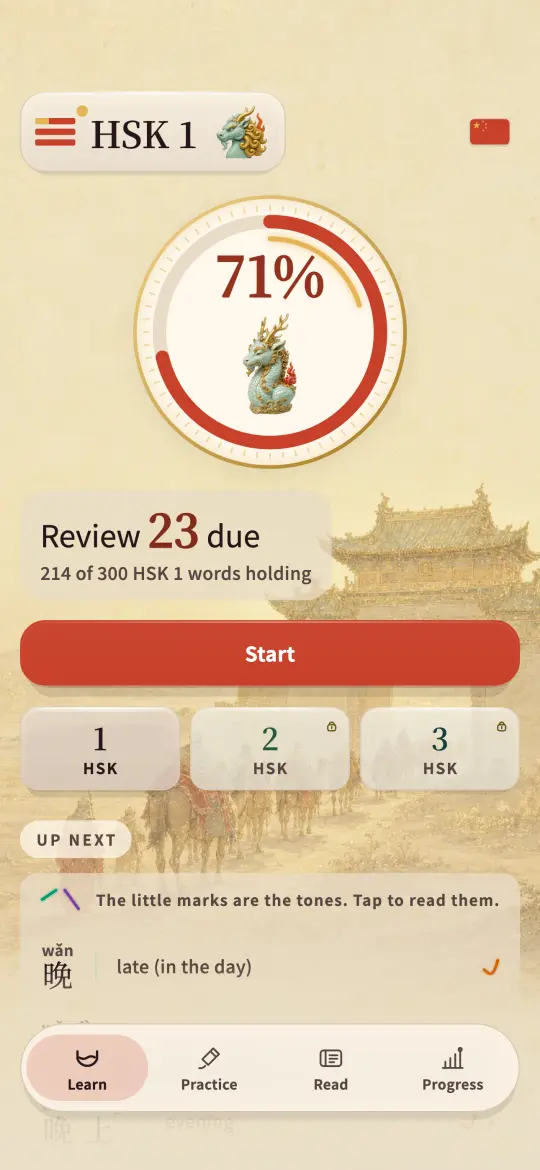
Your recall right now
78%
of HSK 1
Measured from your own reviews, and it decays when you stay away, so it stays honest.
茶
tea
Chinese punishes the app that teaches you something once and moves on. Kylin is tuned for what you can still recall next month, from your first character to the end of HSK 3.
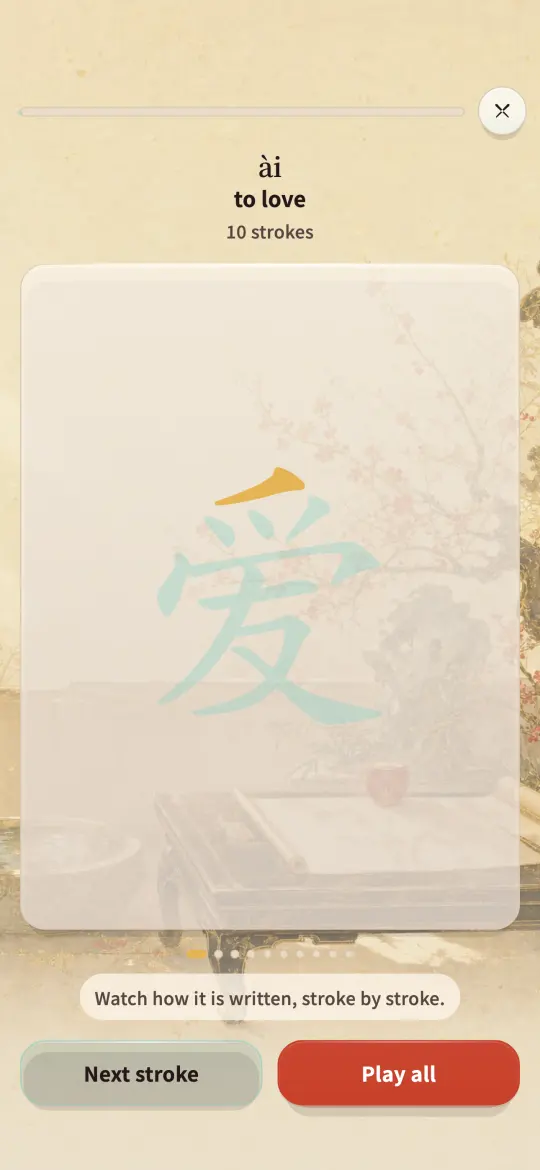
The characters you write by hand are traced in the correct stroke order, and the app grades every stroke: on the line, covered, and in the right direction. It shows you each stroke first, then hands you the brush.
A modern spaced-repetition scheduler brings each word back just before you would forget it. An item leaves the queue when your recall is stable, not because you got it right once.
Naming one tone in isolation is the easy version. Kylin samples across the whole matrix of tone pairs, because the errors that survive are the ones between two tones in a row, and it comes back to the pairs you keep missing.
Characters are taught in the order their components allow, so a new one is usually pieces you already know. The pieces come first, and the characters that use them follow.
Full pinyin while you need it, and one switch to hide it everywhere the moment you want the characters to carry you. The hanzi are never optional.
Progress is a percentage you can prove, not a counter you defend. Miss a week and the number moves down honestly, and new words wait until your reviews are back under control. No guilt screen.
Not an English app with a translated menu. The glosses, the mnemonics, the grammar notes and the reading passages are all written in your language.
Write it in the right order
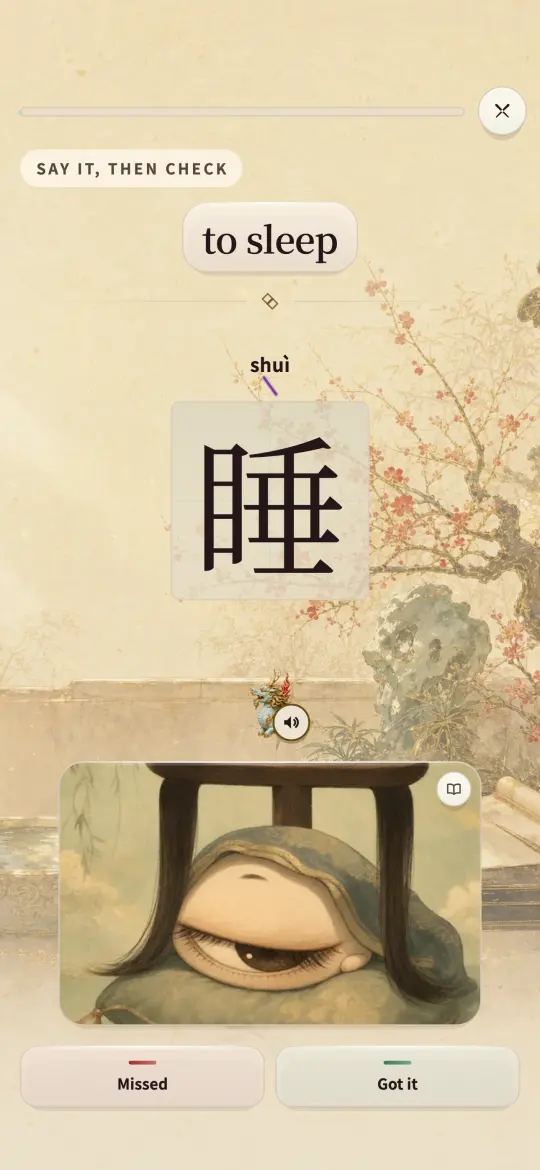
Say it, then check yourself
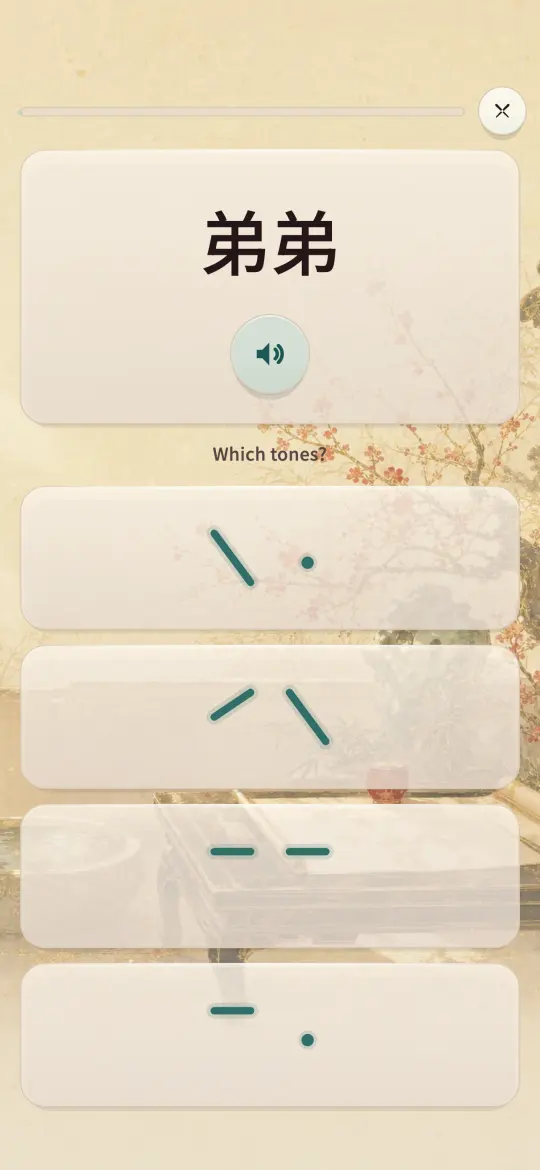
Tones drilled two at a time
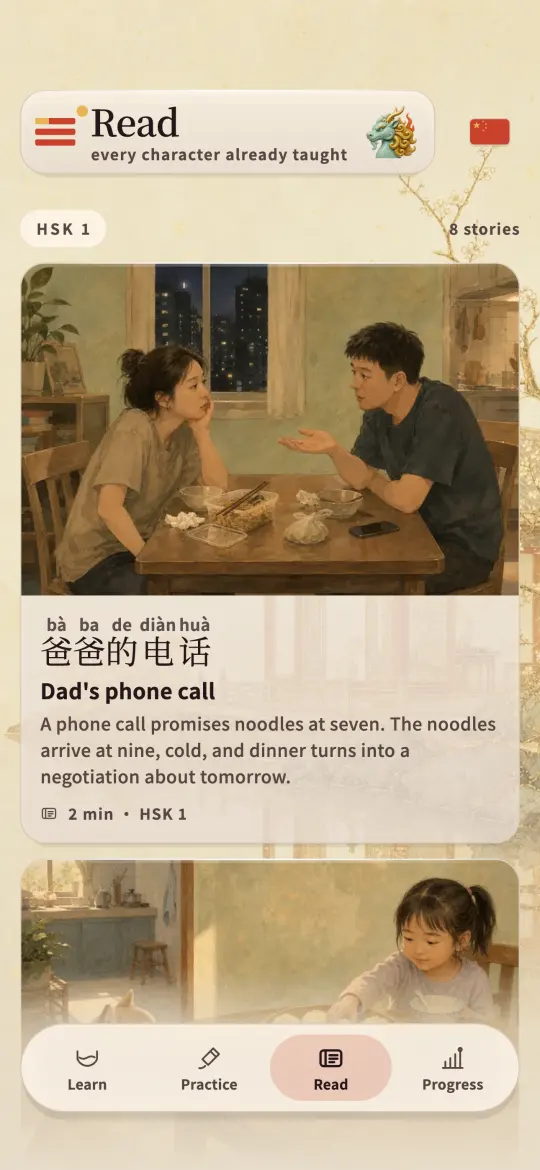
Stories built from what you know
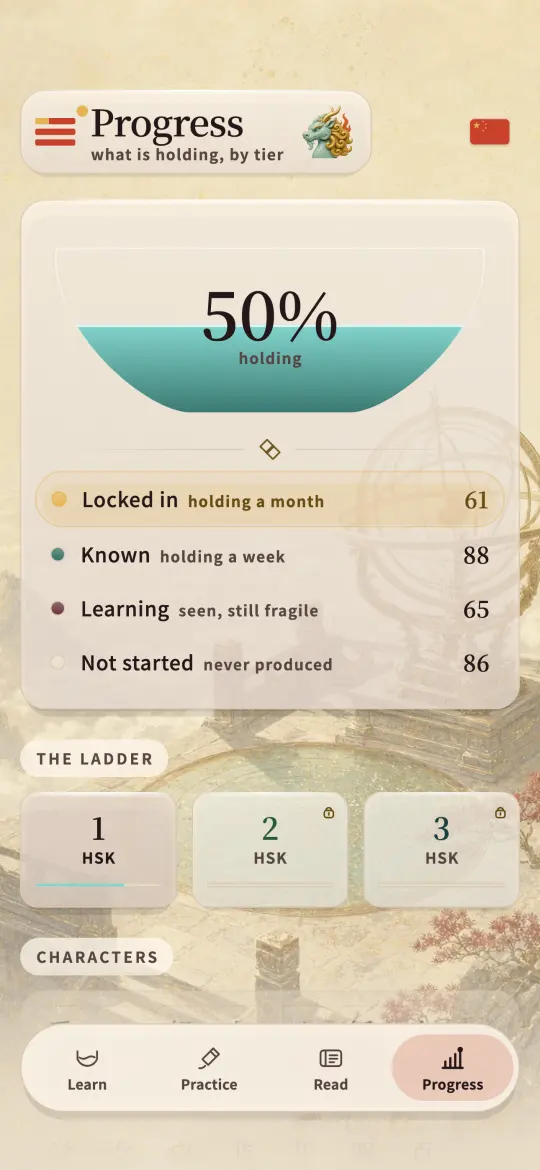
A number you can prove
HSK 3.0 was published in November 2025 and has been in force since July 2026. Its per-level word counts differ from the older standard that most published lists still follow, so these are the words the current syllabus sets for each level.
HSK 1
The whole level, with its grammar, its reader and every stroke animation. Free, with no account and no time limit.
HSK 2
Sentence patterns start carrying real weight here, and reading passages grow past single lines.
HSK 3
The largest jump of the three. By the end you are reading paragraphs rather than decoding them.
Glosses, memory stories, grammar notes and reading passages are written in the language you choose, not only the buttons. The tone drill follows your own answers: the pairs you keep missing come back more often than the ones you have.
See it, hear it spoken, and see the parts it is built from. Where a component tells you something about the meaning, Kylin points it out.
Multiple choice happens once, the first time you meet an item. After that you recall it: the reading, the tone, and the character traced in the right order.
Reviews come up when they are worth doing, and the home screen tells you what you would recall today, computed from every answer you have given. Stay away and it drops on its own, so it cannot flatter you.
Kylin starts you at zero. You meet a character, hear it spoken, and see the components it is built from, and handwriting practice is open from day one. Words, tones and grammar build from there through HSK 1, 2 and 3.
HSK 1 is free in full: all 300 words, all 248 characters, its grammar and its reader. Kylin Pro opens HSK 2 and HSK 3, as a subscription or a one-time lifetime purchase. Prices are shown in the app in your own currency before anything is charged.
The HSK 3.0 syllabus published in November 2025, which has been in force since July 2026. Its word counts differ from the older 2021 standard that most published word lists still use, so the levels in Kylin follow the current syllabus rather than the older lists.
Yes. Every lesson, character, stroke animation and audio clip ships inside the app, and the scheduler runs on your device. Nothing is downloaded while you study.
Twelve: English, Spanish, Portuguese, French, Italian, Russian, Turkish, Japanese, Korean, Vietnamese, Thai and Indonesian. Glosses, mnemonics and grammar notes are written in the language you pick rather than translated on the fly.
No. The home screen shows how much of a level you would recall right now, computed from your own review history. Miss a week and the number tells you the truth instead of taking something away from you.
Yes. Handwriting practice traces characters in the correct stroke order and grades every stroke. Tones are drilled as pairs, because the hard part is telling two tones apart in sequence rather than naming one on its own.
Simplified, which is what HSK uses. Traditional is not in the app today.
Free to start, works with no connection, and there is no streak to keep alive. Reminders exist only if you switch them on. Kylin is on the App Store and Google Play, and the whole of HSK 1 is free.
Kylin includes open reference material that its licences require us to credit, here and inside the app.
CC-CEDICT, a community Chinese to English dictionary, used for definitions and readings, under Creative Commons Attribution-ShareAlike 4.0.
Make Me a Hanzi, used for stroke order and character decomposition. Copyright 1999 Arphic Technology Co., Ltd. and copyright 2016 Shaunak Kishore, under the Arphic Public License.
Kylin is an independent app made by IOCODO LLC. It is not affiliated with or endorsed by any HSK examination body.